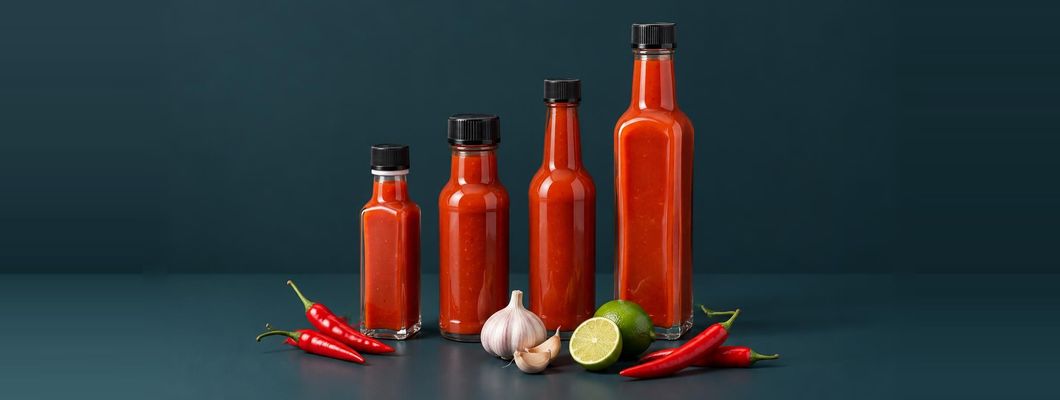
For everyday gifts, start with a 150ml or 200ml sauce bottle, with 60ml and 100ml bottles to consider for tasters, hampers and gift sets. Before the ribbon, the part that matters is the sauce: follow a trusted vinegar-based recipe to the letter, and pick a bottle and cap that suit the recipe’s method and storage instructions.
Our sauce bottle size guide covers the fuller size comparison. Here, we’re concentrating on making, bottling and gifting your sauce, plus what to check if you plan to sell it. We’re sticking to vinegar-based hot sauce, rather than chilli oil.
Of the products below, only our 150ml sauce bottle names hot sauces in its listing, so for the others, have a quick word with Anna about your recipe.
Bottles for tasters, hampers and gift sets
Small bottles for a thoughtful gift
For a Christmas hamper or tasting gift, think about the whole presentation before choosing your bottle. Leave room for a readable label, and check the bottle, cap and recipe together rather than choosing by appearance alone.
Our catalogue lists the 60ml Marasca bottle for oils, vinegars and dressings, alongside product samples and hamper packing. It comes with an 18mm black tamper-evident screw cap.
The 100ml Dorica bottle is listed for sauces, dressings and marinades among its uses. It is supplied with either a 31.5mm black tamper-evident screw cap or a pouring cap. Its two glass colour choices are Dead Leaf / Green and Flint / Clear.
Our 100ml Marasca bottle is listed for olive oils, dressings, syrups and infused liquids, plus samples and hamper packing. It also offers a 31.5mm screw cap or pouring cap, with the screw cap option supplied in black and tamper-evident.
A presentation box for three
For a vinegar-based tasting set, consider the 100ml Dorica / Marasca presentation box. It holds three 100ml Dorica or Marasca bottles and has three display windows and a flip-open front.
Our catalogue lists it for gift packaging and retail presentation, with vinegars among the listed contents.
Try a mild, medium and hot trio in three 100ml Dorica or Marasca bottles, choosing a trusted vinegar-based recipe for each. A handwritten tasting card could give the recipient somewhere to note their favourite.
Plan the bottle labels and tasting card together. Keep storage instructions on each bottle too, rather than putting everything on a card that could become separated from the gift.
Bottles for everyday gifts, market stalls and supper clubs
The 150ml and 200ml sauce bottles
The 150ml (5oz) sauce bottle is a straightforward starting point for an everyday gift. It is about 4cm across the base and comes with a black 24mm screw cap.
For a different presentation, our 200ml (8oz) square sauce bottle is listed for sauces, dressings and marinades, with a tall square profile for shelf display and branded ranges. It comes with a 28mm tamper-evident screw cap, with black, red, gold and green selectable.
For a market-stall range, you could use cap colours to distinguish recipes, then repeat that distinction on the labels. For supper-club tables, give an easily read sauce name and clear allergen information room ahead of decorative wording.
Other bottle shapes to consider
Our 250ml round sauce bottle and 250ml hexagonal bottle are both listed for sauces and dressings and supplied with 43mm twist-off lids. Think about that wider opening when planning how to fill your chosen bottle, while following the recipe’s method.
The tall 250ml Dorica bottle and 250ml Marasca bottle are listed for oils, vinegars, dressings and sauces. Both offer a 31.5mm black tamper-evident screw cap or pouring cap. Check the closure against your intended contents before choosing the pouring option.
Match your spare caps before filling
Check your caps while planning the batch, so they are ready when the sauce is. Keep spare caps identified by the bottle they fit, especially if you are preparing several gift formats.
The black 24R4 screw cap is designed for 5oz sauce bottles. The 28mm Duet cap is listed as fitting 8oz sauce bottles where the confirmed Duet fitment is required.
The 31.5mm black tamper-evident screw cap is listed for sauces among other bottled liquids. Its tamper-evident closure helps show whether the bottle has been opened.
The separate 31.5mm cap with pourer is listed for oils, vinegars and dressings. Both spare closures list compatibility with 250ml Marasca bottles and 100ml, 250ml and 500ml Dorica bottles.
For the smaller Marasca bottles, keep to their own matching spares rather than the broader-fit 31.5mm caps: the black tamper-evident cap for 100ml Marasca bottles or the black tamper-evident cap for 60ml Marasca bottles.
Make and keep a vinegar-based sauce safely
Start with a reputable recipe
Choose your recipe before buying ingredients or printing storage labels. Read it through, including the cooling, container preparation and keeping instructions, so you know what you will need before you start.
BBC Good Food’s hot sauce recipe uses red and green chillies, tomatoes and 150ml apple cider vinegar, among other ingredients. Its method says to leave the sauce to cool, then store it in a sterilised jar.
The recipe states: “Will keep chilled for up to a month in an airtight jar.”
For a recipe that specifically uses bottles, BBC Good Food’s scotch bonnet and mango hot sauce also contains apple cider vinegar. It says to leave the sauce until completely cool before pouring into sterilised bottles.
Its keeping instructions are: “Will keep in a cool, dark place for three months. Once opened, store in the fridge for up to a month.”
Keeping times belong to each recipe, so stick to the one you followed.
Prepare the containers as carefully as the sauce
The Food Standards Agency’s advice on preserving food at home says to use reputable instructions and follow them exactly. That includes temperatures and processing times, as well as the ingredient list.
Use containers suitable for the method, check them for damage and sterilise them when instructed. Follow any sterilising instructions supplied with the containers or preservation equipment. Check suitability before applying a recipe’s treatment to your bottles and caps.
The same guidance recommends washing hands, cleaning and sanitising equipment and work surfaces, and labelling and dating preserved food. Store it as instructed and use it within the recommended keeping time.
If a gift needs chilling, make that part of the handover plan too, so the recipient knows to put it in the fridge rather than leave it in a hamper until Christmas Day.
Why vinegar is not a shortcut
The FSA warns that incorrect preparation, processing or storage can allow harmful microorganisms to grow, including Clostridium botulinum.
Its botulism guidance specifically warns about bottling products such as herbs or garlic in oil at home. It also says home preservation is riskier than buying ready-made food, and recommends reputable recipes and chilling below 5°C to help reduce risk. Keep to a reputable preservation method, rather than improvising your own.
As an example of local advice, Dover District Council’s guidance for pickles and chutneys specifies pH 4.5 or lower and/or water activity below 0.9 throughout the product’s shelf life to control C. botulinum risk.
That is advice for those foods, not a national hot-sauce limit or a substitute for following a reputable recipe. Ask your own local authority about your product if you plan to sell.
Give gifts a helpful label
For a personal gift, keep the label useful as well as attractive. We suggest including:
- The sauce name.
- The ingredients, with any allergens clearly identified.
- The date it was made.
- The storage and keeping instructions for the recipe followed.
- A practical heat description, such as mild, medium or hot.
The heat description is a friendly guide for the recipient, not one of the mandatory sale-label particulars discussed below. Keep it honest rather than turning it into a challenge.
For a Christmas gift, add a personal message on a separate tag. Let the bottle label do the practical work, especially where refrigeration or instructions after opening matter.
Before printing a whole batch of labels, make a paper mock-up on an empty bottle. Check that the words are readable and that your gift wrapping will leave the instructions visible.
What to check before selling
Register and plan your food safety procedures
GOV.UK’s starting a food business guidance says to register with your local authority at least 28 days before trading, including when operating from home or online.
Food businesses must also have food safety management procedures based on HACCP, such as Safer Food, Better Business. Talk through what is appropriate for your sauce-making operation with your local authority.
That guidance covers England, Wales and Northern Ireland. For Scotland, start with Food Standards Scotland. If you are planning a supper club as well as bottled sales, explain both activities when asking for advice.
Check the retail label before printing
For pre-packed retail bottles, GOV.UK’s food labelling guidance requires key particulars including:
- The name of the food.
- A list of ingredients, including allergens.
- The net quantity.
- A best-before or use-by date.
- The food business operator’s name and address.
This list is a starting point for your label. Before printing, read the full guidance and the FSA’s packaging and labelling information, and ask your local authority if you are unsure which requirements apply.
Under the net quantity labelling guidance, pre-packed liquids must show their quantity in millilitres, centilitres or litres, in the same field of vision as the food name. An imperial measure such as 5oz may appear too, but must not be more prominent than the metric quantity.
Check allergens and establish your own shelf life
The FSA’s allergen guidance says businesses must tell customers when food contains any of the 14 declarable allergens. Relevant examples to check include mustard, celery, and sulphur dioxide or sulphites above ten parts per million in the finished product.
Check every ingredient, including your vinegar, so the allergen information reflects the sauce you have actually made. For pre-packed food, allergens must be emphasised each time they appear in the ingredients list.
Finally, establish the shelf life of your own product before setting its date. Food Standards Scotland’s shelf-life guidance explains that businesses must demonstrate that their chosen shelf life is appropriate. Talk to your local authority food team about your recipe, process and packaging. A home recipe’s keeping time is not commercial validation.
Bring your hot sauce gift together
Choose the recipe first, then bring the bottle, matching closure and readable label together. Once those practical details are settled, you can enjoy choosing the ribbon and writing the tasting card.
Explore our oils, dressings and sauce bottles, lids, caps and corks and gift boxes to plan your presentation.
If you would like help matching bottles and closures, speak to Anna at The Bottle Company South on 0117 986 9667.