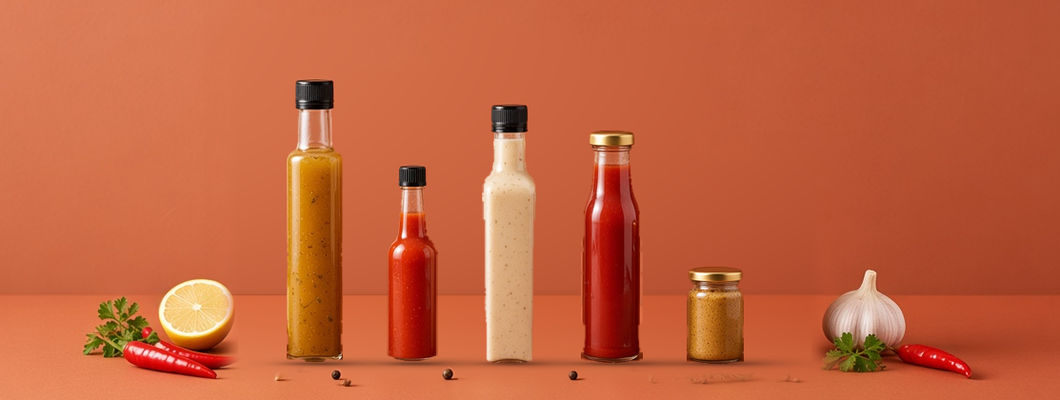
For most homemade dressings and pouring sauces, a bottle of 150ml to 250ml is the practical choice: big enough for several meals, small enough to be used up while it is at its best. Go smaller, at 60ml or 100ml, for samples, tasters and gift sets, and only go up to 500ml for products that keep well and get used quickly, such as an oil or vinegar-based dressing for a busy kitchen. Thick condiments like mustard or a chunky sauce are easier to use from a jar than a bottle. This guide walks through each size using bottles and jars from our range, then covers keeping times, safety and what to check before you sell.
What size sauce bottle should you choose?
Start with how the product is used and how long it keeps, then pick the bottle. As a quick guide:
- 60ml to 100ml: Samples, tasting sets, hampers and small gifts.
- 150ml to 200ml: Slim sauce bottles for hot sauces, marinades and dressings used a splash at a time.
- 250ml: The everyday size for dressings, table sauces and marinades.
- 500ml: Larger batches of products that keep well, for heavy home use or food service.
- Jars of around 100ml to 320ml: Mustards and thick or chunky sauces that need a spoon rather than a pour.
Homemade dressings often have a short life once made (see the keeping times below), so the bottle should match how much your customer will get through in that time. If in doubt, choose the smaller size.
Which small bottles suit samples and gift sets?
Small bottles let people try a new flavour without committing to a full bottle, and they pack neatly into hampers and tasting boxes. The 100ml Dorica and Marasca bottles each come with a choice of a screw cap or a pouring cap (more on that choice below).
60ml and 100ml bottles
- 60ml Marasca bottle with 18mm black tamper-evident screw cap: About 12.5cm high and 3.5cm across the base, with a slim shape. Our catalogue lists oils, vinegars and dressings among its uses, and it is a handy size for samples.
- 100ml Dorica bottle with 31.5mm screw cap or pouring cap: About 14cm high and 4cm across the base, in clear (flint) or dead leaf green glass. Listed for oils, dressings, marinades and sauces.
- 100ml Marasca bottle with 31.5mm screw cap or pouring cap: About 14.5cm high and 3.5cm across the base. Listed for olive oils, dressings, syrups and infused liquids, and for samples and hamper packing.
A gift box for three
- 100ml Dorica / Marasca presentation box: Holds three 100ml Dorica or Marasca bottles, with three display windows and a flip-open front. Three dressings in one box makes a simple tasting set.
Which bottles suit everyday dressings and sauces?
This is the size range most food makers start with. Narrow-necked sauce bottles suit thinner sauces that are poured or shaken out, while a wider 43mm twist-off lid gives a bigger opening for filling.
150ml and 200ml slim sauce bottles
- 150ml (5oz) glass sauce bottle with black 24mm screw cap: About 4cm across the base. Our catalogue lists hot sauces, dressings, marinades and infused oils, and its slim format suits smaller product lines and samples. Spare 24R4 screw caps for 5oz sauce bottles are also available.
- 200ml (8oz) square sauce bottle with 28mm tamper-evident screw cap: About 20cm high and 4.5cm across the base, with a tall square profile. Listed for sauces, dressings, marinades and infused oils. Cap colours on the product page are black, red, gold and green, which can help tell the flavours in a range apart.
250ml sauce bottles with twist-off lids
- 250ml round sauce bottle with 43mm twist-off lid: About 18.8cm high and 5cm across the base, in clear glass so the contents stay visible. Listed for sauces and condiments, including dressings, marinades and syrups. Lid colours are white, gold, silver and black.
- 250ml hexagonal bottle with 43mm twist-off lid: About 18.8cm high and 5.2cm across the base. Listed for sauces, dressings, infused oils and syrups, and the hexagonal shape stands out on a shelf or in a gift pack.
Tall 250ml bottles with a screw cap or pourer
Our 100ml, 250ml and 500ml Dorica bottles and our 100ml and 250ml Marasca bottles each come with a choice of a 31.5mm screw cap or a pouring cap (the 60ml Marasca comes with an 18mm screw cap), so you can pick the closure to suit how the product will be used. The pouring cap helps give cleaner, more controlled pouring of oils, vinegars and dressings, while the tamper-evident screw cap helps show whether the bottle has been opened. For thin, oil-based dressings and vinaigrettes, the pourer is worth considering.
- 250ml Dorica bottle with 31.5mm screw cap or pouring cap: About 23cm high and 4.5cm across the base, with a tall, slim shape. Listed for oils, vinegars, dressings and sauces.
- 250ml Marasca bottle with 31.5mm screw cap or pouring cap: About 21cm high and 4cm across the base. Listed for oils, vinegars, dressings and sauces.
- 31.5mm tamper-evident screw cap with pourer: Our catalogue lists this cap as fitting 250ml Marasca bottles and 100ml, 250ml and 500ml Dorica bottles. For a plain closure on the same bottles, there is also the 31.5mm black tamper-evident screw cap.
When does a 500ml bottle make sense?
A 500ml bottle suits products that keep well and get used in quantity, such as a house dressing for a cafe or a large household. Before you size up, check your recipe's keeping time: a big bottle that has to be thrown away half full is a poor buy for your customer.
- 500ml Dorica bottle with screw cap or pouring cap: About 27.5cm high and 5.5cm across the base. Listed for oils, vinegars, dressings, sauces and syrups.
Which jars work better for thick condiments?
Mustards, relishes and chunky sauces do not pour well from a narrow neck. A jar lets people get a spoon in, and it is easier to fill and clean.
Small jars for mustard
- 106ml (3.5oz) universal mustard jar with 48mm twist-off lid: About 7.8cm high and 4.6cm across the base. Listed for mustards, jams and sweet treats, and useful for samples. Lid colours are gold, silver, black and white.
Larger jars for chunky sauces
- 314ml round passata jar with 63mm twist-off lid: About 11cm high and about 6.3cm across the base. Listed for passata, sauces, preserves and pickled products, with a wide choice of lid colours including red and blue gingham.
For more on matching lids to jars, see our guide to which lids go with jam, honey and pickle jars.
How long do homemade dressings keep?
It depends on the recipe, which is why smaller bottles are often the better choice. Two examples from published recipes:
- BBC Food's three salad dressings recipe says to keep the dressings in a screwtop jar in the fridge: the French dressing, made with fresh garlic, for up to 3 days, and the honey and mustard dressing for up to 5 days. It also notes the oil may solidify in the fridge, so leave it at room temperature for around 30 minutes and whisk or shake before use.
- BBC Good Food's classic vinaigrette, made with just Dijon mustard, red wine vinegar and light olive oil, is stored in a cool place rather than the fridge and "will keep for a week". That week applies to that recipe only.
Always follow the keeping time for the recipe you are using, and label every bottle with the date it was made.
Take care with garlic and herbs in oil
The Food Standards Agency's guidance on botulism warns that "canning and bottling products such as herbs or garlic in oil can be risky" at home, because it is difficult to achieve the control needed to destroy or prevent the growth of C. botulinum spores. It advises using recipes and guidance from reputable sources and chilling food below 5°C. The FSA's advice on preserving food at home also says to label and date preserved foods and use them within the recommended shelf life.
What should you check before selling dressings and sauces?
If you plan to sell, a few rules apply whatever bottle you choose:
- Register first: GOV.UK's guidance on starting a food business says to register with your local authority at least 28 days before you start trading. The same guidance says food businesses must have food safety management procedures based on HACCP, such as the Safer Food, Better Business pack. In Scotland, see Food Standards Scotland.
- Declare allergens: Mustard and eggs are among the 14 allergens in the FSA's allergen guidance for food businesses, as are sulphur dioxide and sulphites above ten parts per million, which can matter for some vinegars and wine-based dressings.
- Show the volume in ml: GOV.UK's net quantity labelling guidance says pre-packed liquids must show their net quantity in millilitres, centilitres or litres, in the same field of vision as the name of the food. Imperial sizes such as 5oz can be shown as well, but must not be more prominent than the metric figure.
Explore our oil, dressing and sauce bottles
Browse the full range in oils, dressings and sauce bottles, find jars for thicker condiments in pickle and chutney jars, and pick up spare closures in lids, caps and corks. For tasting sets, see our gift boxes. If you are bottling oils as well, our guide to choosing oil and dressing bottles for food makers goes into more detail. Not sure which size is right for your recipe? Call Anna and the team on 0117 986 9667.