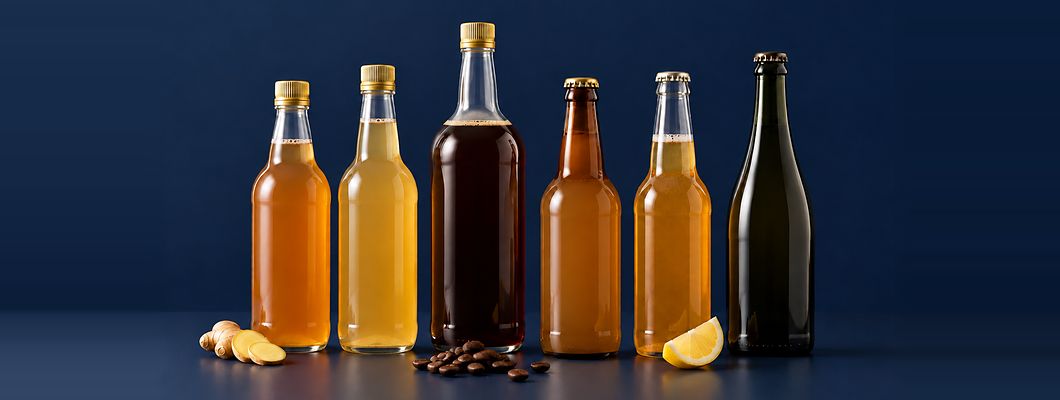
For homemade kombucha and water kefir, choose a bottle whose listing says it is suitable for carbonation. Both can keep fermenting after sealing, so pressure may build. Ordinary cold brew is different: it is usually a still, chilled drink, not a carbonated ferment. Our catalogue lists mineral bottles as suitable for carbonation, beer bottles for beer, cider and other bottled drinks, and a champagne bottle for sparkling beverages. Those descriptions are not interchangeable.
Mineral bottles from 250ml to 500ml suit smaller individual servings, while 750ml and 1 litre bottles suit sharing or larger batches. If you are planning drinks for Dry January, do not assume homemade ferments are alcohol-free. Check the bottle and your method before you start.
What are you bottling?
Kombucha
Kombucha is fermented sweetened tea. After its main fermentation, it is often bottled for a second ferment, sometimes with fruit or another flavouring. That can make it fizzy, but it can also mean more carbon dioxide in a sealed bottle.
Water kefir
Water kefir is a fermented drink that may be bottled for a second ferment. If it is still active after you seal it, pressure can build, just as it can with kombucha.
Milk kefir
Milk kefir is usually cultured in a jar. If you bottle it while it is still active, take the same care with a sealed bottle: fermentation may continue and pressure may build.
Cold brew
Cold brew is coffee steeped in cool or room-temperature water, then strained. Keep it chilled. Unless you are following a tested fermented-coffee method, do not treat ordinary cold brew as a carbonated ferment.
Why does pressure matter in a sealed bottle?
Live yeast can keep using sugars after bottling and produce carbon dioxide. In a sealed bottle, that gas is trapped, so pressure may build. Added fruit, juice or other flavourings can affect how active a second ferment becomes.
A Food Standards Agency recall notice for bottled kombucha warns that over-fermentation can make bottle caps pop off unexpectedly and cause injury. Follow a tested method and choose a bottle whose listing supports the pressure your method may produce.
Our mineral bottle listings say they are suitable for pasteurisation and carbonation. The 1 litre listing says it is suitable for carbonated and pasteurised drinks. The beer bottles are listed for beer, cider and other bottled drinks, and the champagne bottle is listed for sparkling beverages. These listings do not give pressure ratings or confirm suitability for a sealed second ferment.
Check every bottle before filling. Do not use one with chips or cracks. Use the closure specified for that bottle, check it is in good condition, and apply it properly. If a bottle may be under pressure, point it away from faces and open it slowly.
How do you handle a second ferment?
Start with a tested method for your drink. Before filling, wash your hands with soap and warm water, and clean the bottle, closure, utensils and work surfaces. The official food preparation cleaning guidance covers hands, surfaces, utensils and containers.
Some kombucha methods call for about 2.5 to 5cm (1 to 2 inches) of headspace. That gives room at the top, but it does not stop pressure building or make a bottle suitable if its listing does not support carbonation.
Some kombucha methods use a short second ferment at room temperature and call for briefly opening the bottle once a day to release carbon dioxide. This is called burping. Follow the timing and checks in your chosen method, then refrigerate when the drink has reached the level of fizz you want. Do not leave an active ferment sealed at room temperature unattended for long periods.
Fruit, juice or ginger added at bottling can increase carbonation, so release pressure carefully. Refrigerate promptly when your method requires it. The official chilling guidance advises keeping the fridge between 0 and 5°C. Follow the storage advice in your tested method as well. We do not give a keeping time for homemade drinks.
Which bottles does our catalogue list?
Mineral bottles
The mineral bottle listings below say they are suitable for pasteurisation and carbonation, or, for the 1 litre bottle, suitable for carbonated and pasteurised drinks.
- The 250ml mineral bottle with screw lid is a compact personal size. It is listed for drinks including water, juices and soft drinks.
- The 330ml mineral bottle with 28mm tamper-evident screw cap is listed for bottled drinks including water, juices and carbonated beverages.
- The 500ml mineral bottle with 28mm tamper-evident screw cap is listed for drinks including mineral water, soft drinks and flavoured beverages.
- The 750ml mineral bottle with 28mm tamper-evident screw cap offers a larger sharing size and is listed for water, juices and soft drinks.
- The 1 litre mineral bottle with lids is listed for sparkling water, fizzy soft drinks and other carbonated beverages, as well as pasteurised drinks.
- Another personal-size option is the 330ml sloping-neck mineral bottle with 28mm duet cap, also listed as suitable for pasteurisation and carbonation.
Beer bottles
Our 330ml amber beer bottle is listed for small-batch beer production and craft beer packaging. Its amber finish helps protect the contents from UV light, supporting flavour and freshness.
The 500ml amber beer bottle is listed for beer, cider and other bottled drinks. The 500ml clear beer bottle is listed for showcasing bottled beverages including beer and cider. Caps are not included with these beer bottles. Their listings do not give pressure ratings or confirm suitability for a sealed second ferment.
Champagne bottle
The 750ml Champenoise champagne bottle is listed for sparkling beverages, including champagne and prosecco. It has a 29mm crown finish. Corks and cages are not included. The listing does not describe it as suitable for bottling kombucha or kefir.
What closures do they take?
The mineral bottles are supplied with their listed closures: a screw lid, a 28mm tamper-evident screw cap or, on the sloping-neck bottle, a 28mm duet cap. The 1 litre listing says lids are supplied.
Beer bottles are not supplied with caps. Our catalogue lists crown beer bottle caps and a desktop capper with fittings for 26mm and 29mm crown caps. The capper is described as a bench-top option for applying crown caps to beer bottles. Check the closure specified for your particular bottle before filling.
The champagne bottle has a 29mm crown finish, and its listing says corks and cages are not included. Although the capper listing mentions a 29mm fitting, check closure compatibility with the bottle before filling.
Are you selling what you bottle?
If you sell food or drink, including from home, read the GOV.UK guidance on starting a food business. You need to register with your local authority at least 28 days before you start trading, and follow allergen information and labelling rules.
Common bottling questions
Which bottles are listed as suitable for carbonation?
The mineral bottles described above are listed as suitable for pasteurisation and carbonation, or, for the 1 litre bottle, for carbonated and pasteurised drinks. The beer and champagne bottle listings use different descriptions, so do not assume they have the same stated suitability.
Do you need to burp the bottles?
Some tested kombucha methods call for briefly releasing pressure during a room-temperature second ferment. Follow the timing in your chosen method, and do not rely on headspace alone to manage pressure.
Does cold brew need the same pressure care?
Ordinary cold brew is usually a still, chilled drink, so it is not the same as an active ferment in a sealed bottle. Keep it chilled and use a tested method if you are deliberately making fermented coffee.
Can you use a beer or champagne bottle?
Our catalogue lists beer bottles for beer, cider and other bottled drinks, and the champagne bottle for sparkling beverages. Those listings do not give pressure ratings or confirm suitability for a sealed second ferment, so check before filling.
If you are choosing bottles for a new batch, you can browse our mineral bottle range, beer and cider bottle range, or wine and champagne bottle range. For help choosing a bottle or for a trade enquiry, speak to Anna at The Bottle Company South on 0117 986 9667.